SupportNetworkHome Care in Parramatta
Whether you’re planning ahead or need help quickly, Support Network helps people in Parramatta find reliable home care without the agency mark-ups.
- Support at Home, Home Care Packages and private care
- Personal care, cleaning, meals and companionship
- Consistent workers you choose

Help at home that keeps life familiar
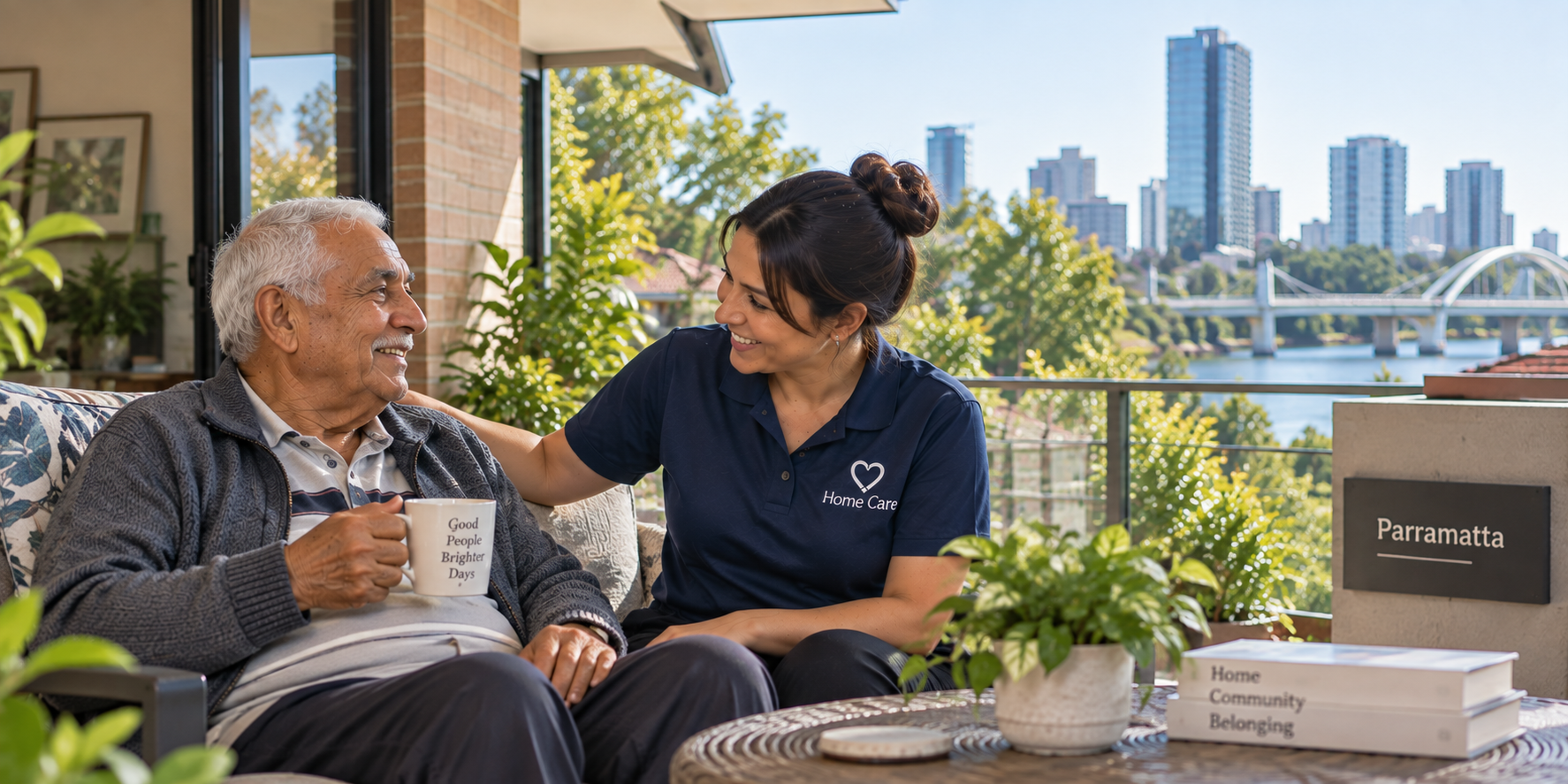
Home care in Parramatta through Support Network means help with the everyday — personal care, housework, meals, transport and company — from workers you choose and get to know.
Use your Support at Home or Home Care Package funding, or pay privately. Either way you avoid unnecessary agency margins.
- Personal care and medication prompts
- Cleaning, laundry and gardening
- Meal preparation and shopping
- Transport and appointments
- Respite for family carers
Why people in Parramatta choose us
Screened workers
Every worker passes police and Working With Children checks before they can be booked.
Lower fees
A 6% client fee means more of your funding goes into actual support hours.
Your choice
Pick workers by skills, languages, gender, interests and availability.
Compliance handled
Records, invoices and insurance are managed through the platform.
Support available in Parramatta
Daily living & life skills
Housework, meal prep, shopping, transport and building everyday skills.
Personal support
Showering, dressing, hoist transfers, mobility and continence support.
Nursing services
Wound care, medication management, catheter and complex clinical care.
Allied health
Occupational therapy, psychology, physiotherapy and speech therapy.
Specialised disability support
Workers experienced with complex needs, behaviours and conditions.
24 hour & overnight support
Build a rostered team for around-the-clock or sleepover care.
Getting started is simple
Sign up
Create your free profile in a few simple steps.
Search
Browse screened local workers by skills, languages and availability.
Connect
Message workers, meet them, and choose the people who fit.
Relax
We handle payments, records and admin so you can focus on living.
Home Care in Parramatta: common questions
Can I use my Home Care Package in Parramatta?
Yes. If your provider allows self-management or brokered services, our workers can be engaged through your package. We can explain the steps.
Do you offer private home care?
Yes — you can pay privately with no package or NDIS plan required.
Is there a minimum number of hours?
Minimums are set by individual workers and are usually around two hours per visit.
Can I meet the worker first?
Absolutely. We encourage a meet-and-greet before regular shifts begin.
More services in Parramatta
Need extra help? We are always available for you.
Our dedicated team can help you find support workers and manage your support whenever you need it.
Let’s figure it out together
No pressure. No confusion. Just clear, kind guidance — one step at a time.
Personal care, help around the house, nursing and good company — arranged with support workers based in western Sydney, in a suburb where the hospital is close and the buildings are getting taller.
- Workers based in western Sydney
- Apartment and building access sorted
- Language-matched support available
- No agency margin on your rate
one of Australia's largest health precincts on your doorstep
you pay for nursing and allied health, whatever your income
personal care becomes fully funded for everyone
The home care services we provide in Parramatta
Everything your funding covers, arranged around your routine. Start with one visit a week or build up to daily support — the mix is yours to decide.
Showering, dressing, grooming, continence support and help with mobility — delivered with patience by someone you know and trust.
Domestic assistance
Cleaning, laundry, bed changes and the household jobs that get harder — keeping your home the way you like it.
Shopping and cooking meals you actually want to eat, including the food you grew up with, prepared the way you prefer.
Social support & community access
Company at home, outings, appointments, clubs or place of worship — the connection that keeps life feeling like your own.
Getting to medical appointments, the shops, family visits and errands — with someone who comes in with you if you would like.
Planned breaks so the person doing most of the caring can rest, work, or have an afternoon that belongs to them.
Overnight & sleepover support
Someone in the home through the night — for safety, night-time assistance, or to give a family carer an unbroken sleep.
Wound care, medication management, continence support and clinical oversight from registered nurses — fully funded, so it costs you nothing.
Allied health & therapy
Occupational therapy, physiotherapy and podiatry, including home assessments that often reduce how much paid support you need.
Clinical services cost you nothing
Nursing, occupational therapy, physiotherapy and podiatry are fully government funded under Support at Home, with no contribution regardless of your income or assets. And from 1 October 2026 personal care becomes fully funded too.
What home care in Parramatta involves
Parramatta has changed more in fifteen years than almost any part of Sydney, and the people ageing here are doing it in two quite different kinds of housing.
The hospital precinct is a genuine advantage
Westmead sits minutes from central Parramatta, and it is one of the largest health precincts in the country — Westmead Hospital, the Children's Hospital, Westmead Private, plus the research institutes, specialists, imaging and pathology that cluster around them. Cumberland Hospital is close for mental health services.
For someone managing several conditions, that concentration is worth more than it sounds. Appointments that would take a full day from the outer suburbs can be done in a morning. Community access hours go further because the destinations are close together. And follow-up after a hospital stay is straightforward rather than a logistical problem.
It matters most at discharge. If someone is coming home from Westmead, call us before the discharge rather than after. Support organised while they are still on the ward consistently works better than support assembled in the days afterwards, and it is the single biggest factor in whether someone stays home or is readmitted within a fortnight.
Two kinds of Parramatta home
The suburb splits cleanly for home care purposes, and which side you are on changes what support looks like.
The apartment towers around the CBD, Parramatta Square, Harris Park and along the river have brought a large number of older residents into high-density living — some who downsized deliberately, others who moved to be near adult children. The recurring practical issue here is building access: fobs, intercoms, lift keys, security doors, visitor parking and building manager permissions. Left unresolved, every visit starts with a small negotiation and every new worker has to solve the building from scratch. We sort it once at the beginning.
The older brick homes through North Parramatta, Northmead, Westmead, Telopea and Dundas are a different proposition — lowset or split-level, on decent blocks, often owned by the same family for forty years. Here the issue is usually the property rather than the building: the yard, the step down to the laundry, the bathroom that has nothing to hold onto.
Telling us which you are in when you call shapes the visit more than almost anything else.
Language and cultural matching
Parramatta and the suburbs around it are among the most culturally diverse in Australia. Harris Park has one of the largest Indian communities in the country, with substantial Chinese, Lebanese, Arabic-speaking, Korean, Sri Lankan and Afghan communities across Granville, Merrylands, Westmead and Auburn nearby.
For home care this is not a background detail. When a support worker and an older client do not share a language, communication drops to the functional minimum, symptoms go unreported because nobody could describe them, meals arrive that nobody eats, and personal care is frequently refused outright.
We match on language, cultural background and gender. When you call, be specific about the exact language — Hindi and Punjabi are different, as are Mandarin and Cantonese, and a mismatch is nearly as unhelpful as no match at all. Tell us too if gender matters for personal care, which in many Parramatta households it does. Both are rostering facts we plan around, not awkward requests.
One thing worth anticipating: people with dementia often lose later-acquired languages while keeping their first. Someone who has spoken confident English for forty years may revert primarily to Hindi, Arabic or Cantonese as dementia progresses — at which point an English-only worker genuinely cannot communicate with them.
Starting before the crisis
Because Westmead is so close, Parramatta families often reach us at the worst possible moment — someone has had a fall, they are on a ward, and everything must be arranged in four days.
Support assembled in that window is worse in every way. There is no time to meet workers or choose someone suitable, availability is whatever exists that week, and the person receiving support has no say in it at exactly the moment they feel they have lost control of everything else. If language matching matters, the odds of finding the right person in four days are poor.
Starting earlier — while someone needs a hand with the cleaning and the shopping rather than personal care — costs less, gives you real choice about who comes, and builds a relationship before it is urgently needed. If you are reading this while things are still mostly fine, that is the best possible time to call.
Tell us when you call
Building access — fob, intercom, lift, security door.
The exact language, if matching matters.
Whether you need a male or female worker.
Westmead and discharge
Westmead, the Children's Hospital and Westmead Private are all minutes away.
If a discharge is coming, call before it happens — it is the biggest factor in avoiding a readmission.
Why families choose us
Most providers send whoever is rostered. We work differently, and it changes both what you pay and who walks through your door.
Local workers, not dispatched ones
We look first at who already lives near Parramatta. A worker travelling across Sydney arrives late, charges travel, and eventually stops accepting the shift. A local one lasts years.
You choose your own support worker
You speak with or meet people before anything is arranged, and you decide. If someone is not the right fit, we keep looking — that is normal, not a complaint.
Your funding buys more hours
Because there is no agency margin between you and your worker, our rates run roughly $45 to $70 an hour against $70 to $95 through traditional agencies. On a mid-level classification that is around three extra hours of support every week.
The same person, week after week
Continuity is what makes support work. Someone who knows your routines notices when something has changed — and that is how problems get caught early rather than becoming emergencies.
Straight answers about money
We send a full written price list before you commit, explain exactly what your funding covers, and tell you plainly if we are not the right fit for what you need.
Rated 4.9 out of 5
From 157 Google reviews across our disability and aged care services.
Already with a provider?
You can change at any time. Your funding follows you and there are no exit fees. We handle the changeover so there is no gap in your support.
Tell us your suburb and we will tell you who is available
No cost, no obligation. If we cannot find the right person for you nearby, we will say so.
What home care costs in Parramatta
Almost no aged care provider publishes rates. We do, because comparing them is the most useful thing you can do — and because ours hold up.
| Service | With Support Network | Typical full-service agency |
|---|---|---|
| Personal care, weekday | $45–$70/hr | $70–$95/hr |
| Domestic assistance | $45–$62/hr | $65–$88/hr |
| Social support & community access | $45–$65/hr | $68–$90/hr |
| Overnight sleepover | Flat rate, from ~$280 | $280–$450/night |
| Nursing & allied health | Fully funded — $0 to you | Fully funded — $0 to you |
Indicative Sydney ranges for 2026. Weekend and public holiday loadings apply. We send a full written price list before you commit.
What that difference is worth
Take a Classification 5 participant: $39,697 a year, released as $9,924 a quarter. After the 10 percent care management deduction, roughly $8,932 a quarter is available for services.
| Hourly rate paid | Hours per quarter | Hours per week |
|---|---|---|
| $88 — typical agency rate | 101.5 | about 7.8 |
| $62 — with Support Network | 144 | about 11.1 |
That is roughly three and a quarter extra hours of support every week, from exactly the same funding.
What you contribute
Your out-of-pocket contribution is a percentage of the service price, set by an income and assets assessment through Services Australia. Clinical care is free to everyone. Personal care and other independence services attract 5 to 50 percent depending on your means; everyday living services such as cleaning and gardening 17.5 to 80 percent.
A full pensioner paying for a $65 hour of personal care contributes $3.25. A self-funded retiree without a health card contributes $32.50. Both pay nothing for nursing.
One piece of paperwork worth doing
If you have not completed your income and assets assessment with Services Australia, you are recorded as “means not disclosed” and charged the maximum contribution rate regardless of your real circumstances. Some people skip it for privacy and end up paying self-funded-retiree rates on a pension income.
Do not let funding go to waste
Support at Home funding arrives quarterly, and you can carry over only $1,000 or 10 percent of the quarterly budget, whichever is greater. Anything above that returns to the government when the quarter closes. On Classification 6, underspending by $5,000 in a quarter means losing around $3,825 permanently.
We keep an eye on this for the people we support and flag it while there is still time to bring services forward.
No hidden charges
Providers cannot charge separate administration, entry or exit fees. The service price is the whole price.
Price caps were legislated for 1 July 2026 but deferred in May 2026, so rates vary between providers. Comparing published price lists is your protection.
Funded separately
Equipment and home modifications come from their own stream, so rails and ramps do not eat your service hours.
Restorative Care — around $6,000 for up to 16 weeks, often used after a hospital stay or a fall.
Four steps, and the first one is a phone call that costs nothing.
Tell us what you need
Call 1300 671 931. Tell us your suburb and street, the type of home, your classification if you have one, and the support you are looking for. If you do not have funding yet, we will explain what to expect from My Aged Care.
We look for workers nearby
We start with people who already live close by and match what you have asked for — times, gender, language, experience. You see who is available rather than being assigned someone.
You meet them and decide
Speak with or meet the people we suggest before anything is locked in. You choose. If the first person is not right, we keep looking.
Support starts, and we stay in touch
Your worker begins on the schedule you agreed. We check it is working, watch your quarterly budget so nothing is lost, and adjust as things change.
Do not have funding yet?
Start with My Aged Care on 1800 200 422. Waits between approval and funding commonly run three to six months, so it is worth starting before you urgently need help. Many families use us privately during that wait and simply continue with the same worker once their plan begins.
One piece of advice that matters more than any other: at your assessment, describe the hardest day of a normal week, not the easiest. Assessments often happen on a good morning, families soften the picture out of protectiveness, and the classification ends up reflecting a performance rather than a life.
Coming home from hospital?
Call before discharge, not after. Support arranged while someone is still in hospital works far better than support scrambled together once they are home — and it is the biggest single factor in avoiding a readmission.
Questions people ask us
Yes. We arrange support workers across Parramatta and the surrounding area, including North Parramatta, Harris Park, Westmead, Northmead, Telopea. When you contact us we look specifically for workers who already live nearby rather than sending someone across Sydney — in our experience that is the single biggest factor in whether an arrangement lasts.
In most cases yes. Parramatta and the surrounding suburbs have large Indian, Chinese, Arabic-speaking, Korean, Sri Lankan and Afghan communities, and the support workforce reflects that. Tell us the exact language when you call — Hindi and Punjabi are not interchangeable, and neither are Mandarin and Cantonese. We will tell you honestly what is available in your area.
Not at all — a growing share of the Parramatta clients we support live in units. The one thing worth sorting properly at the start is building access: fobs, intercoms, lift keys and visitor parking. We arrange it once rather than leaving each worker to negotiate it, which removes a surprising amount of weekly friction.
Our support worker rates in Sydney typically run $45 to $70 an hour for personal care and domestic assistance, compared with roughly $70 to $95 an hour through traditional full-service agencies. Weekend and public holiday loadings apply. Nursing and allied health are fully government funded under Support at Home, so they cost you nothing regardless of income or assets. We send a full written price list before you commit to anything.
No. We work with Support at Home participants, people who transitioned from a Home Care Package, Commonwealth Home Support Programme clients, and privately funded families. Many people start with us privately while waiting for funding to be allocated, then continue with the same worker once their plan begins.
Support at Home replaced Home Care Packages on 1 November 2025. There are eight classifications, ranging from about $10,731 a year at level 1 to about $78,106 at level 8, released in quarterly budgets. Ten percent of each quarter goes to care management before services are purchased. Amounts are indexed each 1 July — confirm current figures with My Aged Care on 1800 200 422.
Yes, and this is central to how we work. You speak with or meet workers before anything is arranged, you decide who supports you, and you can change if it is not the right fit. Support is personal work, and compatibility matters as much as qualifications.
You can change at any time and your funding follows you — there are no exit fees under the current rules. We handle the changeover, including liaising with your previous provider, so there is no gap in your support. Most people find switching considerably easier than they expected.
From 1 October 2026, personal care — showering, dressing, grooming and continence assistance — is reclassified as a clinical support, making it fully government funded with no participant contribution within your allocated budget.
Prefer to just talk?
Most questions are quicker to answer on the phone, and there is no obligation at the end of it.
Let's find the right support worker near you
Tell us your suburb, your classification and what you need. We will tell you plainly who is available nearby, what it will cost, and how soon we can start.
Monday to Friday. No cost, no obligation.